



Are intrusive thoughts a sign of a mental health disorder?
Everyone sometimes experiences intrusive/ obsessive thoughts. In the case of obsessive-compulsive disorders (OCD), the mere fact that such thoughts appear is interpreted as a manifestation of personal responsibility. A thought becomes more than just a thought (an event in the mind) – it means that something is going to happen or that “we are something” (e.g., bad). The person having such thoughts feels personally responsible for preventing the consequences of thoughts.
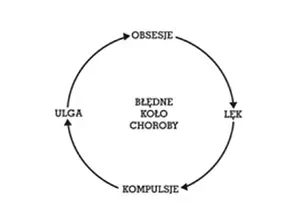
This leads to an even greater discomfort and to constant attempts (compulsions, intrusive activities, including mental activities) at eliminating thoughts for which the person feels responsible. Compulsion also serves as a means to reduce anxiety and discomfort.
The crux of the problem is the belief in the importance of intrusive thoughts. Rituals (behaviour or thinking rituals), avoidance and reassurance are the three type of activities that nourish the vicious cycle of symptoms (they strengthen the thought repetition mechanism). The more rituals (compulsions) a person performs, the more meaningful a given thought is, so it will reappear. Moreover, the temporary reduction of an anxiety with a compulsion teaches both our minds and bodies to repeat such an activity (the anxiety drops a bit -> the mind thinks that “it works”). However, it only works for a while, so it needs to be repeated. Once the compulsion is well-grounded, it is difficult to eradicate. The functioning of the person begins to deteriorate.
Intrusive thoughts reflect crucial issues that are important to all moral systems (aggression, sex, blasphemy, chastity) and therefore obsessions are often perceived as sinful, disgusting, and shameful. Such misinterpretation of these thoughts only escalates and perpetuates the obsession.
Thoughts on morally difficult topics are misinterpreted as proving that someone is “sinful” or “a bad person”. The mind spontaneously produces many thoughts that do not have to mean anything.
Some factors responsible for catastrophic interpretations of thoughts include:
- high moral standards
- low mood, anxiety
- cognition disorders (fusion of thoughts and actions; inflexibility)
- beliefs established as a result of various experiences (regarding high personal responsibility, overestimating the threat, regarding morality, perfectionism, the need to control the environment, etc.).
The fusion of thinking and acting is a cognitive distortion. It is based on the idea that having a thought about an event increases the probability of that event or even causes it (e.g, if I think that my husband may die in an accident, I will actually cause his death). The obsessive fear of doing something wrong or terrible becomes tantamount to actually wanting to commit the act (e.g. if I think about hurting children it means I really want to hurt them) or shows the “true nature” of a person (e.g. I must be a bad person if I have such terrible thoughts.). Such mistaken reasoning often makes us try to control our thoughts or suppress them at all costs.
The spectrum of obsessive-compulsive disorders includes dysmorphophobia, hoarding, trichotillomania (a hair-pulling disorder), and induced dermatitis (recurrent scratching, skin damage). One of the types of OCD is ROCD – Relationship OCD which involves obsessions and compulsions about being in a relationship or about our partner.
One of the most effective treatment strategies for obsessive compulsive disorder is Exposure and Response Prevention Therapy. Cognitive techniques are also used to treat the OCD symptoms. Mindfulness techniques are often incorporated into therapies.
Make an appointment with us:
Remote reception hours: Monday to Friday, from 2:00 PM to 6:00 PM
If we don’t answer, please leave us a message via SMS or WhatsApp, and we will call you back as soon as possible. For email inquiries, we kindly ask you to include your contact number.
Other issues
See our services
How we provide support (also available online) and the languages we offer
Read articles on this topic:

I can’t stand making mistakes – perfectionism
In the strategy of perfectionism, we constantly strive to meet the high standards we set for ourselves, despite the negative consequences that may arise (e.g., fatigue, stress, procrastination). We base

About habits
Today, a brief guide for working on healthy habits. We can start with an exercise that only requires a few minutes. Working on changing habits takes time, but it’s worth
Worrying – how to master your thinking?
When we worry excessively, we often experience a sense of “chaos” in our minds, a racing of thoughts, a feeling of being in a tunnel of anxiety, concentration difficulties, and